| |

Q: Who is Jane?
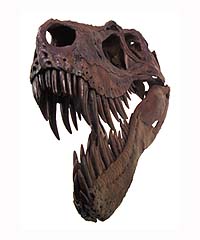
A: Jane is the fossilized skeleton of a juvenile T. rex discovered in 2001 by a Burpee Museum expedition to the Hell Creek Formation in southeastern Montana.
Q: Is Jane really a girl?
A: No one knows for sure. There are about 35 T. rex skeletons in the entire world. We don't know the sex of any of them, not even "Sue" or "Stan", the two largest and most complete specimens ever discovered. When it comes to sex, the scientific jury is still out.
Q: What is Burpee Museum of Natural History?
A: Burpee Museum has been a Rockford landmark and scientific educator for nearly 65 years. The museum is housed in a 42,000 square-foot facility with administrative offices in two historical mansions. It's located adjacent to Riverfront Museum Park on the west bank of the Rock River in downtown Rockford, along with the award-winning Discovery Center children's museum and the Rockford Art Museum.
Q: Where is Rockford?
A: Rockford, the third largest city in Illinois, is located in north-central Illinois at the juncture of I-90, I-39 and US Highway 20, just a 60-minute drive west of Chicago's O'Hare International Airport. Rockford's population is about 152,000; the metro area is about 400,000.
Q: What and where is the Hell Creek Formation?
A: It is a geological formation with outcroppings in eastern Montana, eastern Wyoming and western North and South Dakota. It dates back 67 million years ago to the late Cretaceous Period, when it was a lush, warm-temperate flood plain. Today, it is an arid and harsh "badlands" of rugged buttes, deep ravines and rocky outcroppings, a treasure-trove of fossilized plants and animals. The area where Jane was found is near Ekalaka, Montana, population 450, the county seat of Carter County. The dig site was a 60-minute, jouncing, tire-ripping drive from town.
Q: What is the Cretaceous Period?
A: The Cretaceous Period lasted from 144 to 65 million years ago. It was the final period of the Mesozoic Era, the "Age of Dinosaurs." In the Late Cretaceous Period, animals like Triceratops and T. rex roamed what is today North America. Mammals were also present, but none grew much larger than an opossum. The end of the Cretaceous Period is marked by a mass extinction that wiped out all of the dinosaurs and many other kinds of animals, including mosasaurs (giant swimming reptiles) and pterosaurs (flying reptiles).
Q: How was Jane discovered?
A: In the summer of 2001, Burpee Museum sent a 14-member team to Hell Creek for three weeks. Members included museum staff, volunteers and amateur paleontologists. They were "prospecting" for fossils. That meant they could scan the ground for fossils, but couldn't do any excavating. On the last day, two team members, Bill Harrison and Carol Tuck, discovered Jane. Harrison found a toe bone, and Tuck found a leg bone. (Harrison is a Spanish and Portuguese language professor at Northern Illinois University in DeKalb; Tuck is a CPA and the spouse of a Burpee board member.) It was time to go home, plus, they didn't have an excavation permit. They camouflaged the site with rocks and dirt, hoping it would remain hidden until a Burpee team could return in 2002 with the proper permits to excavate and remove bones.
Q: Who owns the land where Jane was discovered?
A: The land is owned by the US Bureau of Land Management (BLM) a division of the US Department of the Interior. The BLM issues exploration and excavation permits. Very little of the land is tillable. Its primary use is grazing, hunting, recreation, mining and dinosaur-hunting.
Q: Why the name Jane?
A: The dinosaur was named after Jane Solem, a Burpee benefactor who (together with her husband Robert) endowed a major museum addition. Robert Solem, a longtime Rockford resident, never forgot the experience of finding his first fossil. As a young man, he was a regular visitor to Burpee Museum, eventually joining its board of directors and generously supporting the growth and programs of the museum. And what does Jane Solem have to say about all of this? "This brings families together. You can develop a common interest, and you'll have a better family relationship if you do interesting and educational things like this with your kids."
Q: How has Burpee Museum paid for the Jane project?
A: Through grants, cash and in-kind donations from local businesses and individuals, including: AMCORE Bank, Eclipse Foundation, Estwing Manufacturing Company, Hamilton-Sundstrand, LaSalle Bank, Illinois Public Museum Capital Grants Program, Ringland-Johnson Construction Company, Rockford Area Convention & Visitors Bureau, Rockford Blacktop, Rockford Park District, Rockford Park District Foundation, R. Ray & Nola Wood, Smith Family Foundation, Kohler Charitable Trust, Illinois Bureau of Tourism, and Woods Equipment Company.
Q: How will Jane change the way we think about T. rex?
A: Because Jane is by far the world's best specimen of a juvenile T. rex, further study of her skeleton will reveal important aspects concerning the changes that happened during growth as T. rex grew from a hatchling to its colossal mature size.
Q: Has Burpee found any more fossils at Hell Creek?
A: Yes! Most of a Triceratops skull, bones from a Pachycephalosaurus and a duckbilled dinosaur, plus teeth from a T. rex.
Q: Were any other fossils found with Jane?
A: Yes! The soil and rock encasing Jane's remains were a rich source of fossilized flora and fauna from her era. The biggest surprise was the neck vertebra of a pterosaur with a wingspan of about 20 feet. All fossils has been catalogued and can be seen alongside the Jane exhibit.
|
|
|
|





;)